Growth Mindset Report Card Comments: 24 Examples
Struggling to word feedback kindly and honestly? Use these growth mindset report card comments, plus simple before-and-after swaps, to write comments parents will actually read.
Read in
Growth Mindset Report Card Comments: 24 Examples
It's late. You have 20 comments left. You just typed "Liam is a poor listener" for the third time this week.
You delete it because it sounds harsh. Then you stare at the blank box.
Growth mindset report card comments fix this problem. They let you stay honest about where a student is. They also avoid sounding like a fixed verdict. Instead of "he can't," you write "he's working on it, and here's what helps."
This guide explains what these comments are. You'll get five quick word swaps, a simple formula, and 24 examples to copy into your report cards.
What Are Growth Mindset Report Card Comments?
A fixed mindset treats ability as something you either have or don't. A growth mindset treats it as something that grows with effort, good strategies, and support.
In a report card, that means describing what the student does and what comes next. It doesn't mean labeling the child.
It also doesn't mean pretending everything is fine. Imagine a parent seeing 'Sara is doing great next to a failing grade they will feel confused. Good growth mindset comments stay honest and still leave the door open.
Comments matter more than most of us admit. A grade shows a result, but not the story behind it. A short comment can tell a family what the child can do now and what to practice next.
5 Quick Swaps to Reword Negative Comments
You don't need to memorize a system. Just change the wording in these common spots.
Instead of: Ben is bad at math. Try: Ben is building his math skills and benefits from extra practice with multiplication.
Instead of: Ava never finishes her work. Try: Ava is learning to manage her time and finishes more tasks with reminders.
Instead of: Noah is a poor listener. Try: Noah would benefit from listening more carefully during lessons.
Instead of: Mia isn't a strong writer. Try: Mia is developing her writing and is ready to add more detail.
Instead of: Jay gives up easily. Try: Jay is learning to keep trying when work feels hard.
Look at the third swap. Calling a child a "poor listener" describes who they are. Saying they should listen more carefully focuses on improvement. The behavior is identical, but the message differs. Prodigy's report card guide recommends this kind of reframing.
Here is another easy trick from Education World. Take a positive comment and turn it into a goal. "Sam cooperates consistently" becomes "Sam needs to cooperate more consistently. " You can build a needs-work comment in seconds this way.
A Simple Formula for Any Growth Mindset Comment
Most good comments have three parts:
What the student does well or has improved. Keep it true and specific.
What they're working on. Use words like "developing," "working on," or "learning to."
What helps next. Add a strategy, a support, or a small goal.
Keep it to two or three sentences. Parents skim, so short comments land better.
24 Growth Mindset Report Card Comments to Copy
Replace [Name] and the blanks to fit each student.
Effort and Persistence
[Name] puts real effort into every assignment. That effort shows in [his/her/their] steady progress in [subject].
[Name] is learning that hard work takes time. [He/She/They] now stays with tasks longer than before.
[Name] asked for help when stuck this term. That habit will keep paying off.
With regular practice, [Name] has grown more confident in [skill]. I'm excited to see that continue.
Learning From Mistakes
[Name] now sees mistakes as part of learning. [He/She/They] uses feedback to improve [his/her/their] work.
When a task goes wrong, [Name] is learning to try a new strategy instead of stopping.
[Name] revised [his/her/their] writing this term. The final draft showed clear growth.
I've noticed [Name] checking work more carefully. That care is improving [his/her/their] accuracy.
Academic Areas to Grow
[Name] is still developing [skill]. Short daily practice at home would help build fluency.
[Name] hasn't mastered [concept] yet. [He/She/They] is making progress with hands-on examples.
Reading comprehension is a growth area for [Name]. Talking about the story after reading together can help.
[Name] is working on showing steps in math. This will make [his/her/their] thinking easier to follow.
Focus and Work Habits
[Name] is learning to stay on task during independent work. A checklist has been helping.
[Name] is developing organization skills. [He/She/They] is getting better at keeping materials ready for class.
[Name] is working on finishing assignments on time. Breaking tasks into smaller steps is starting to work.
[Name] would benefit from setting a small goal each day. I'll support this in class.
Behavior and Social Skills
[Name] is learning to wait [his/her/their] turn to speak. I've seen progress when we use a reminder.
[Name] is working on collaborating with classmates. [He/She/They] does better when roles are clear.
[Name] is practicing calm responses when frustrated. [He/She/They] is using strategies more often.
[Name] is a caring classmate. [He/She/They] is learning to bring that same kindness into group work.
Looking Ahead
Next term, we'll focus on [goal]. I'm confident [Name] can grow in this area with continued support.
I'm proud of the progress [Name] has made. I look forward to seeing [him/her/them] take on new challenges.
[Name] has set a goal to improve [skill]. We'll check progress together next term.
Thank you for supporting [Name] at home. Together, we can keep this progress going.
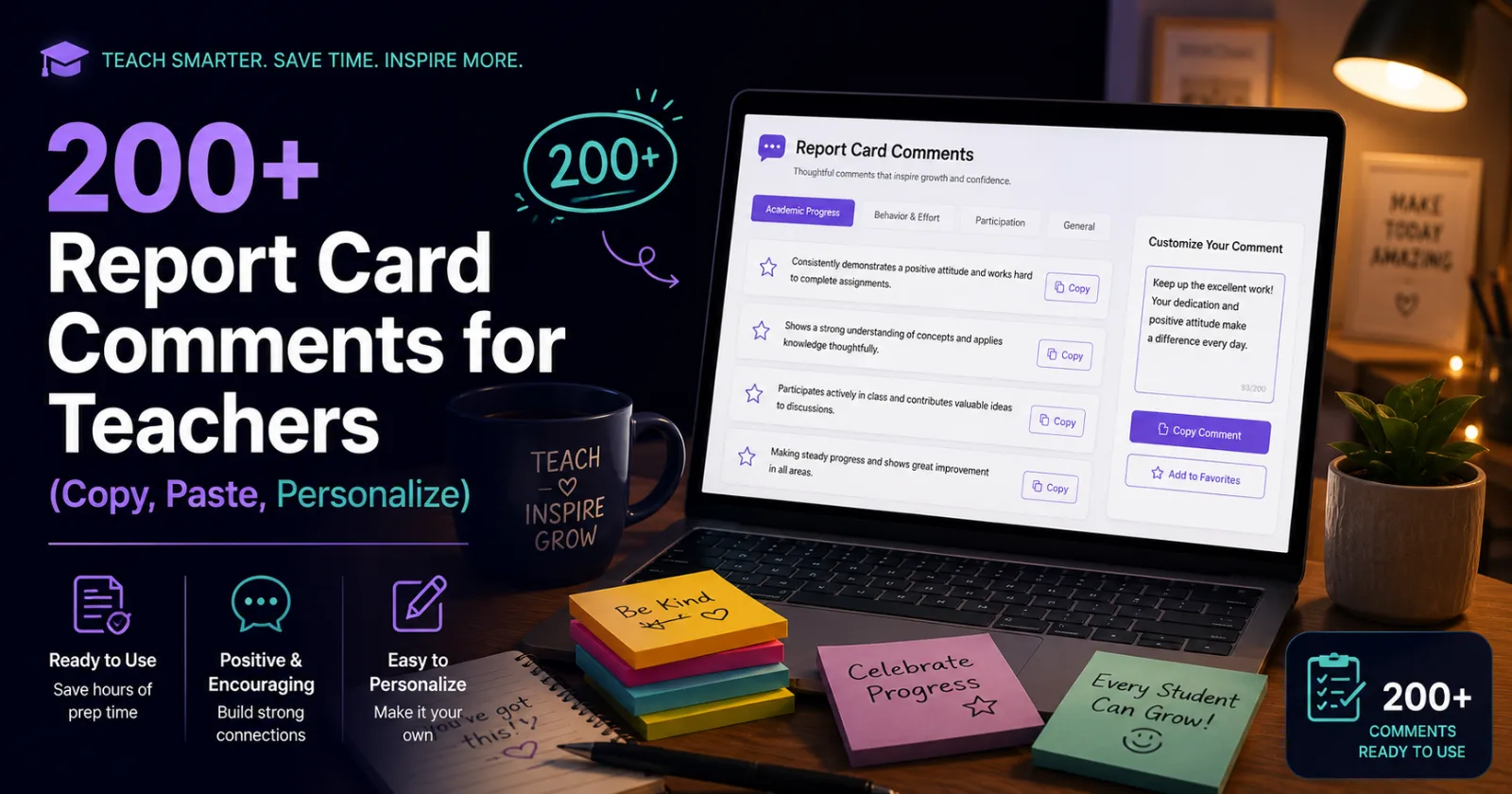
Want more ready-made options? Our list of 200+ report card comments covers every category. You can mix them with the ones above.
Mistakes to Avoid With Growth Mindset Comments
Empty praise. "Great job!" with nothing behind it doesn't help anyone. Name the specific thing the student did.
Overusing "yet." It's a nice word. But if every comment says "not yet," parents will notice. Vary your language.
Hiding real concerns. Growth mindset is not a way to avoid hard news. If a child is far behind, say so clearly and describe the plan. Then send a short note home. Our Parent Email Writer can help you write it kindly.
Writing an essay. Two or three sentences is plenty for most students.
Save Time This Report Card Season
You can write every comment yourself, and many teachers prefer to. But a stack of 30 reports can feel endless.
Our free Report Card Comments Generator drafts personalized comments by grade, subject, and tone. Then you edit the lines that need your personal touch.
Frequently Asked Questions
What are growth mindset report card comments?
They are comments that describe a student's effort, progress, and next steps. They avoid fixed labels like "weak" or "bad at."
How long should a report card comment be?
Two or three sentences work best for most students. Parents tend to skim, so short comments are more likely to be read.
Where to Read More
Teacher Comments on Report Cards from Practical Assessment, Research & Evaluation
114 Meaningful Report Card Comments from The TPT Blog
50 "Needs Improvement" Report Card Comments from Education World
The Takeaway
Growth mindset report card comments aren't softer. They're more useful. Point to real progress, name what comes next, and describe the support that will get the student there.
Do that, and even a "needs improvement" comment reads as a plan, not a judgment.
Keep reading