200+ Report Card Comments for Teachers (Copy, Paste, Personalize)
200+ ready-to-use report card comments for teachers, organized by category. Copy, paste, personalize — save hours this report card season.
Read in
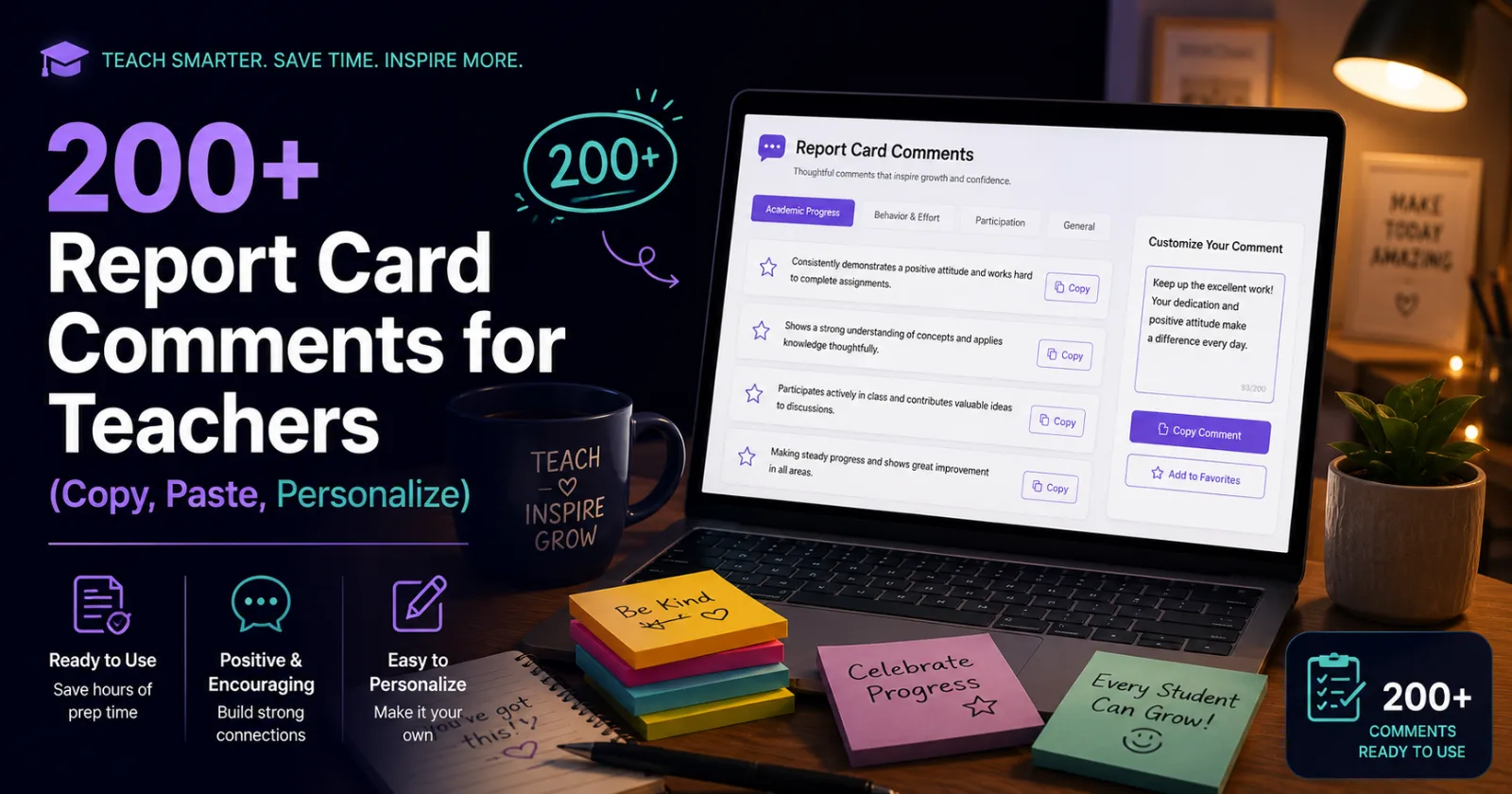
Quick Answer: Looking for report card comments for teachers that actually save time? The fastest way is to keep a categorized comment bank on hand — academic performance, effort, behavior, and skill-specific notes — then swap in the student's name and one specific detail. Below you'll find 200+ ready-to-use comments, organized by category, so you can copy, paste, and personalize instead of starting from a blank box every time.
It's Sunday night, report cards are due Monday morning, and you're staring at student number 24 with absolutely nothing left in the tank. Sound familiar?
Writing thoughtful, specific comments for every single student is one of the most time-consuming parts of teaching — and it happens multiple times a year, every year.
That's exactly why how to write report card comments fast matters so much this time of term. This guide gives you a real, usable comment bank plus a faster workflow, so you're not reinventing the wheel for every child in your class.
What Makes a Good Report Card Comment?
A good comment does three things: it's specific, it's balanced, and it sounds like it was actually written about that child, not copied from a template with the name swapped in.
Parents read report card comments closely, often more closely than the grades themselves. Vague comments like "doing well" don't tell them much — specific ones do.
Report card comments for teachers work best when they combine a clear observation with a forward-looking note, so parents know both where their child stands and what's next.
Why a Comment Bank Saves So Much Time
Keeping a bank of comments ready to go isn't cutting corners — it's working smarter during one of the busiest weeks of the term.
• You stop starting from a blank box. Even a rough starting point is faster than staring at an empty field.
• Comments stay more consistent. A bank helps you keep tone and detail level even across 25 or 30 students.
• You reduce repetitive strain on your evenings. Report card season already eats enough personal time without every comment being written from scratch.
• Personalization still happens. You're not copying blindly — you're swapping in real details, so comments still feel genuine.
• It scales for every term. Once you have a bank, it works for the next report card cycle too, not just this one.
A comment bank is the difference between 30 seconds per student and five minutes per student.
How to Use This Comment Bank Fast
Here's the quickest way to turn this list into finished report cards.
Step 1: Sort Your Students by General Category
Before you start, mentally group students into rough categories — strong performers, steady progress, needs support, behavior notes — so you know which sections to pull from.
Step 2: Pick a Base Comment That Fits
Scan the relevant category below and pick a comment close to what you'd say naturally. You don't need a perfect match, just a solid starting point.
Step 3: Swap in the Name and One Specific Detail
Replace [Name] with the student's name, and add one real detail — a project, a subject, a moment from class — so the comment doesn't feel generic.
Step 4: Combine Two Comments if Needed
For students who need more nuance, combine an academic comment with a behavior or effort comment for a fuller picture.
Step 5: Speed It Up Further With a Generator
If you're writing comments for a full class, Teachlet's [free report card comments generator](https://teachlet.site/tools/report-card-comments-generator) can create personalized comments in seconds based on the details you give it — no sign-up needed.
The Comment Bank: 200+ Ready-to-Use Comments
Browse by category and grab what fits. Replace [Name] with your student's name as you go.
Outstanding Academic Achievement
1. [Name] consistently produces high-quality work and shows a strong grasp of this term's material.
2. [Name] has shown excellent understanding across all subject areas this term.
3. [Name] approaches challenging work with confidence and consistently succeeds.
4. [Name] demonstrates a deep understanding of key concepts and applies them well.
5. [Name] is a strong, capable learner who takes pride in doing quality work.
6. [Name] consistently exceeds expectations on assignments and assessments.
7. [Name] shows excellent critical thinking skills when working through problems.
8. [Name] has a clear strength in [subject] and continues to build on it.
9. [Name] produces thorough, well-organized work across every subject.
10. [Name] grasps new concepts quickly and applies them with confidence.
11. [Name] consistently earns strong results through genuine effort and understanding.
12. [Name] shows real depth of thinking in class discussions and written work.
13. [Name] has mastered this term's core learning goals with ease.
14. [Name] is an academically strong student who sets a great example for peers.
15. [Name] tackles difficult material with a positive, capable attitude.
16. [Name] consistently applies feedback to improve future work.
17. [Name] shows strong retention of material from earlier in the term.
18. [Name] performs consistently well across both written and verbal assessments.
19. [Name] demonstrates excellent problem-solving skills in [subject].
20. [Name] is on track to exceed the learning goals set for this term.
Needs Academic Improvement
21. [Name] would benefit from additional practice with [specific skill] going forward.
22. [Name] is making progress but still needs support to fully grasp [topic].
23. [Name] shows understanding in class but needs more consistency on independent work.
24. [Name] would benefit from reviewing [topic] before we move to the next unit.
25. [Name] has the ability to succeed but needs to focus more consistently in class.
26. [Name] is working below grade level in [subject] and would benefit from extra support.
27. [Name] understands concepts when explained one-on-one but struggles with independent application.
28. [Name] would benefit from additional practice at home with [skill].
29. [Name] shows effort but needs to build stronger foundational skills in [subject].
30. [Name] is capable of stronger results with more consistent focus.
31. [Name] needs to slow down and check work carefully before submitting.
32. [Name] would benefit from asking questions sooner when something feels unclear.
33. [Name] is developing key skills but needs continued practice and repetition.
34. [Name] has shown some progress this term but still has room to grow in [subject].
35. [Name] needs additional support to catch up to grade-level expectations.
36. [Name] would benefit from a consistent homework routine to reinforce class learning.
37. [Name] struggles with [specific skill] and would benefit from targeted practice.
38. [Name] is capable of more and would benefit from setting clearer personal goals.
39. [Name] needs to review foundational concepts before building on new material.
40. [Name] would benefit from extra practice time to strengthen [subject] skills.
Effort and Participation
41. [Name] consistently puts in strong effort, even when the work is challenging.
42. [Name] actively participates in class discussions and shares thoughtful ideas.
43. [Name] shows a genuine willingness to try new approaches to problems.
44. [Name] works hard and doesn't give up easily when facing difficulty.
45. [Name] contributes regularly to class discussions and group activities.
46. [Name] takes initiative and often goes beyond the minimum requirements.
47. [Name] shows real dedication to improving, even in subjects they find difficult.
48. [Name] consistently completes assignments with care and attention to detail.
49. [Name] would benefit from participating more actively in class discussions.
50. [Name] shows increased effort this term compared to previous terms.
51. [Name] approaches new challenges with a positive, can-do attitude.
52. [Name] is beginning to raise their hand more often and share ideas confidently.
53. [Name] puts thoughtful effort into homework and classwork alike.
54. [Name] shows real enthusiasm for learning new material.
55. [Name] would benefit from staying focused for longer stretches during independent work.
56. [Name] consistently asks good questions that show genuine curiosity.
57. [Name] tries their best even when material feels unfamiliar or difficult.
58. [Name] shows steady improvement in how much effort they put into daily work.
59. [Name] takes pride in their work and it clearly shows in the results.
60. [Name] would benefit from putting more consistent effort into homework completion.
Behavior and Attitude
61. [Name] is respectful, kind, and a pleasure to have in class.
62. [Name] follows classroom routines and expectations consistently.
63. [Name] treats classmates and staff with consistent respect and courtesy.
64. [Name] shows excellent self-control, even in challenging moments.
65. [Name] would benefit from being more mindful of classroom expectations.
66. [Name] is generally well-behaved but can be easily distracted by peers.
67. [Name] shows a positive attitude toward both learning and classroom routines.
68. [Name] needs occasional reminders to stay on task during independent work.
69. [Name] handles disagreements calmly and respectfully.
70. [Name] is a positive presence in the classroom and supports a good learning environment.
71. [Name] would benefit from working on managing frustration during difficult tasks.
72. [Name] consistently follows instructions the first time they're given.
73. [Name] shows maturity in how they handle classroom responsibilities.
74. [Name] is generally respectful but occasionally struggles with impulse control.
75. [Name] demonstrates strong self-discipline during transitions and group work.
76. [Name] would benefit from using a calmer tone when frustrated.
77. [Name] is a positive role model for classroom behavior expectations.
78. [Name] shows consistent honesty and integrity in their work and interactions.
79. [Name] needs continued support managing behavior during unstructured time.
80. [Name] has shown noticeable improvement in behavior and self-regulation this term.
Reading Skills
81. [Name] reads with strong fluency and clear expression.
82. [Name] shows excellent comprehension of both fiction and non-fiction texts.
83. [Name] would benefit from practicing reading aloud more regularly.
84. [Name] is building stronger vocabulary through consistent independent reading.
85. [Name] confidently identifies main ideas and supporting details in texts.
86. [Name] needs continued practice with reading comprehension strategies.
87. [Name] enjoys reading and often chooses books above their comfort level.
88. [Name] would benefit from slowing down to improve reading accuracy.
89. [Name] shows strong inference skills when discussing texts in class.
90. [Name] is developing stronger decoding skills with continued practice.
91. [Name] reads confidently but would benefit from working on expression and pacing.
92. [Name] shows a genuine love of reading and often shares book recommendations.
93. [Name] would benefit from additional support with unfamiliar vocabulary.
94. [Name] demonstrates strong comprehension when reading independently.
95. [Name] needs continued practice connecting texts to prior knowledge.
96. [Name] participates actively in reading discussions with thoughtful insights.
97. [Name] is building stamina for longer independent reading sessions.
98. [Name] would benefit from practicing reading a wider variety of genres.
99. [Name] shows strong recall of key details after reading.
100. [Name] continues to grow as a confident, capable reader.
Math Skills
101. [Name] shows a strong grasp of this term's math concepts.
102. [Name] applies problem-solving strategies confidently and accurately.
103. [Name] would benefit from additional practice with [specific math skill].
104. [Name] shows solid number sense and works through problems logically.
105. [Name] needs continued practice to build fluency with basic math facts.
106. [Name] demonstrates strong reasoning when explaining their math thinking.
107. [Name] would benefit from double-checking work to catch small errors.
108. [Name] shows confidence tackling multi-step word problems.
109. [Name] needs continued support connecting new concepts to previous learning.
110. [Name] consistently shows their work clearly, which supports accuracy.
111. [Name] would benefit from more practice with [specific math skill] at home.
112. [Name] shows steady improvement in math confidence this term.
113. [Name] approaches challenging problems with patience and persistence.
114. [Name] needs continued practice to strengthen mental math skills.
115. [Name] demonstrates a strong understanding of key math vocabulary.
116. [Name] would benefit from slowing down during timed practice to reduce errors.
117. [Name] shows real growth in applying math concepts to real-world problems.
118. [Name] needs additional support with foundational math skills.
119. [Name] consistently completes math work with care and accuracy.
120. [Name] continues to build confidence and competence in math this term.
Writing Skills
121. [Name] writes clearly and organizes ideas in a logical sequence.
122. [Name] shows strong use of descriptive language in creative writing.
123. [Name] would benefit from reviewing grammar and punctuation basics.
124. [Name] demonstrates strong voice and creativity in written work.
125. [Name] needs continued practice organizing ideas before writing.
126. [Name] shows steady improvement in sentence structure and clarity.
127. [Name] would benefit from expanding ideas with more supporting detail.
128. [Name] writes confidently across a range of genres and formats.
129. [Name] needs continued support with spelling and basic mechanics.
130. [Name] shows strong editing skills when reviewing their own work.
131. [Name] would benefit from practicing writing longer, more detailed pieces.
132. [Name] demonstrates a clear understanding of paragraph structure.
133. [Name] needs continued practice with proper capitalization and punctuation.
134. [Name] shows genuine creativity and original thinking in writing tasks.
135. [Name] would benefit from reading their work aloud to catch errors.
136. [Name] writes with a clear sense of audience and purpose.
137. [Name] needs continued support developing stronger topic sentences.
138. [Name] shows growing confidence when sharing writing with the class.
139. [Name] would benefit from expanding vocabulary used in written work.
140. [Name] continues to grow as a thoughtful, capable writer.
Social Skills and Teamwork
141. [Name] works well with classmates and contributes positively to group work.
142. [Name] shows strong listening skills during partner and group activities.
143. [Name] would benefit from being more open to others' ideas during group work.
144. [Name] is a supportive classmate who encourages others.
145. [Name] shares materials and takes turns respectfully during group tasks.
146. [Name] would benefit from participating more actively in group discussions.
147. [Name] shows strong leadership qualities when working in groups.
148. [Name] is well-liked by classmates and builds positive friendships easily.
149. [Name] would benefit from practicing compromise during group disagreements.
150. [Name] consistently includes others and helps create a welcoming classroom.
151. [Name] shows empathy and kindness toward classmates.
152. [Name] would benefit from speaking up more during collaborative work.
153. [Name] works effectively in both small groups and whole-class settings.
154. [Name] shows growing confidence interacting with new or unfamiliar peers.
155. [Name] would benefit from listening more before responding during discussions.
156. [Name] is a cooperative, dependable partner during group projects.
157. [Name] shows strong conflict-resolution skills when disagreements arise.
158. [Name] would benefit from being more patient with classmates during group work.
159. [Name] consistently shows respect for differing opinions and ideas.
160. [Name] continues to build strong, positive relationships with classmates.
Attendance and Punctuality
161. [Name] has excellent attendance and arrives to class ready to learn.
162. [Name] is consistently punctual and prepared for the school day.
163. [Name] would benefit from more consistent attendance to support learning progress.
164. [Name] arrives on time and settles into class routines quickly.
165. [Name] has shown improved attendance and punctuality this term.
166. [Name] would benefit from arriving a few minutes earlier to prepare for the day.
167. [Name] consistently comes to class with materials ready.
168. [Name] would benefit from more consistent punctuality throughout the week.
169. [Name] has maintained strong attendance despite a busy term.
170. [Name] arrives ready to focus and start the school day on time.
Growth Mindset and General Progress
171. [Name] has shown real growth in confidence and skill this term.
172. [Name] approaches setbacks with a positive, resilient attitude.
173. [Name] is beginning to see mistakes as part of the learning process.
174. [Name] shows steady, consistent progress across all subject areas.
175. [Name] would benefit from continuing to build confidence in their own abilities.
176. [Name] has made noticeable improvement since the start of the term.
177. [Name] embraces new challenges with curiosity and determination.
178. [Name] shows increasing independence in managing their own learning.
179. [Name] continues to grow as a well-rounded, capable learner.
180. [Name] would benefit from setting small, achievable goals each week.
181. [Name] is developing a stronger sense of ownership over their learning.
182. [Name] shows real pride in their progress this term.
183. [Name] continues to build resilience when facing difficult tasks.
184. [Name] would benefit from reflecting more on what strategies work best for them.
185. [Name] has grown significantly in both confidence and capability this term.
186. [Name] shows a genuine willingness to learn from mistakes.
187. [Name] is developing stronger self-awareness about their own strengths and needs.
188. [Name] continues to make steady, encouraging progress week over week.
189. [Name] would benefit from celebrating small wins along the way to bigger goals.
190. [Name] has grown into a more confident, capable learner this term.
Leadership and Responsibility
191. [Name] consistently takes responsibility for their own learning and materials.
192. [Name] shows strong leadership when guiding group activities.
193. [Name] would benefit from taking more initiative during independent tasks.
194. [Name] is dependable and follows through on classroom responsibilities.
195. [Name] sets a positive example for classmates through consistent effort.
196. [Name] would benefit from stepping into more leadership roles during group work.
197. [Name] takes ownership of mistakes and works to correct them.
198. [Name] is trusted by classmates and staff to handle responsibilities well.
199. [Name] shows growing maturity in how they manage classroom responsibilities.
200. [Name] continues to develop as a responsible, dependable member of the class.
Common Mistakes Teachers Make With Report Card Comments
A few small habits can undercut even a strong comment bank if you're not careful.
Mistake 1: Copying Comments Without Personalizing Them
Using the exact same comment for multiple students, word for word, is easy for parents to notice and can feel impersonal.
Fix: Always swap in one real detail — a project, a moment, a specific subject — even when using a template comment.
Mistake 2: Only Focusing on Weaknesses
A report full of only "needs improvement" comments can feel discouraging, even when accurate.
Fix: Pair growth areas with at least one genuine strength for balance.
Mistake 3: Being Too Vague to Be Useful
Comments like "doing fine" don't give parents anything actionable to work with at home.
Fix: Include one specific skill or subject whenever possible, even in a short comment.
Mistake 4: Waiting Until the Last Minute
Cramming every comment into one exhausted evening often leads to rushed, repetitive writing.
Fix: Draft a few comments each day in the week leading up to the deadline instead of all at once.
Writing Comments Manually vs. Using a Generator
Approach
Time Per Student
Best For
Writing from scratch
3–5 minutes
Small classes, highly personalized notes
Using a comment bank
1–2 minutes
Most teachers, most terms
Using an AI generator
Under 1 minute
Large classes, tight deadlines
Pro Tips for Faster, Better Report Card Comments
• Keep a running notes file on each student throughout the term, so you're not relying on memory at report card time.
• Batch similar students together, writing comments for strong performers, then steady performers, then those needing support.
• Read comments aloud before finalizing — awkward phrasing is easier to catch by ear.
• Save your best comments in a personal bank for next term, not just this one.
• Balance tone across the report, so strengths and growth areas both come through clearly.
• Use a generator for volume, and save your own personal touches for the students who need extra care in the wording.
Why Teachlet's Comment Generator Is Worth Trying
Even with 200+ comments to pull from, a full class still takes time to personalize one by one. Teachlet's [report card comments generator] builds on the same idea — you give it a few details about the student, and it writes a personalized, ready-to-use comment in seconds.
It's free, requires no sign-up, and is built specifically around what teachers actually need at report card time: fast, professional, parent-ready comments.
Frequently Asked Questions
How many report card comments do I actually need?
Most teachers need one to three comments per student, covering academic performance, effort, and sometimes behavior. Having a bank of 200+ comments gives you enough variety to avoid repeating the exact same wording across your class.
Is it okay to use the same comment for multiple students?
It's fine to use a similar base comment, but it's best to personalize each one with a specific detail so it doesn't feel copy-pasted. Parents often compare notes, so some variation matters.
How long should a report card comment be?
Most effective comments are one to three sentences — long enough to be specific, short enough to stay clear and readable. Overly long comments can bury the key point parents need to see.
Can AI tools write report card comments for me?
Yes, tools like Teachlet's report card comments generator can create personalized comments in seconds based on details you provide. It's worth reviewing each one briefly to make sure it fits the student accurately.
What should I do if a student needs a difficult comment?
Focus on specific, constructive language rather than general criticism, and always pair it with at least one strength. A comment bank with balanced options makes this easier to get right.
How far in advance should I start writing report card comments?
Starting a week or two before the deadline, even just a few comments a day, makes the process far less overwhelming than writing everything the night before. A comment bank makes this daily approach much faster.
Final Thoughts: Stop Starting From Scratch
Knowing how to write report card comments fast really comes down to having the right starting points ready before you sit down to write.
Bookmark this list, pull from it each term, and personalize as you go. Between this comment bank and a free generator for the busiest weeks, report card season doesn't have to eat your entire weekend again.
Keep reading